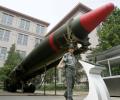
Despite four disarmament section talks and six strategic dialogues between the two foreign ministries, China's intransigence on recognising Indian nuclear status resulted in no confidence building measures in the nuclear field between the two, says Srikanth Kondapalli.

The United States on Sunday said it may use nuclear weapons if the country comes under biological attacks, according to a repot in Dawn. Secretary of State Hillary Clinton said on Sunday the US could not rule out using nuclear weapons, saying in that case "all bets are off."

In the wake of the recent hostilities, both sides have moved from weapons to words, with India dispatching several delegations to visit more than 30 capitals across the world. A similar effort by Pakistan is set to start on Jun 2.

Top military officials from India and Pakistan highlighted their views at the Shangri-La Dialogue in Singapore, billed as Asia's premier defence forum, amid heightened tensions between the two sides following last month's military confrontation.
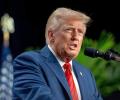
Trump said that leaders in India and Pakistan are "great leaders" and "they understood, and they agreed, and that all stopped".

Russian Foreign Minister Sergey Lavrov on Wednesday warned that a third World War, should it break out, will be "nuclear and devastating", amid spiralling tensions with the West over Moscow's ongoing massive military operation against Ukraine.

Pakistan's fourth heavy water reactor at Khushab nuclear site which allows it to build a larger number of miniaturised plutonium-based nuclear weapons now appears to be operational, a US think-tank has said.
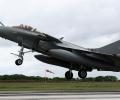
The western media is going all out to prove that India suffered a major setback in Operation Sindoor and how China helped shoot down Indian fighter jets. One of the articles published in British newspaper Telegraph stated Operation Sindoor shattered the myth of India's air dominance over Pakistan. "The Pakistani Air Force, aided by Chinese targeting satellites and AWACS executed a sensor-fusion kill. The Rafales never got a lock, never even saw their adversary. When the missiles hit, it was already over," wrote the British Newspaper, The Telegraph.
"We have eyes onto the Iranian nuclear programme and we would be aware of any so-called breakout move by the Iranians towards building a nuclear weapon. That has not occurred, but that window of opportunity will close at some point," the White House Press Secretary, Jay Carney, told media persons at his daily news conference.

Russian President Vladimir Putin will make a two-day visit to India from December 4 to hold annual summit talks with Prime Minister Narendra Modi that is expected to produce a plethora of significant outcomes, including in the defence sphere, to further solidify the bilateral strategic ties.
Primarily aimed at India, Pakistan is making qualitative and quantitative improvements to its nuclear arsenal and "could increase the number of circumstances under which it would be willing to use nuclear weapons," a Congressional report has said.
India has sought an 'unequivocal commitment' from all nuclear-weapon states to prohibit development, production and stockpiling of nuclear weapons for their non-discriminatory and verifiable elimination within a specified framework. Indian Ambassador to the UN, Nirupam Sen appealed to member states to use the UN forum for an intense dialogue and strengthen the international community to initiate concrete steps for a nuclear weapons-free world.
India is solely responsible for prompting Pakistan to pursue a nuclear weapons capability, says Retired Pakistani Brigadier General Feroz Khan, erstwhile insider in Islamabad's nuclear weapons establishment. Aziz Haniffa reports.
Chief of Army staff General Deepak Kapoor on Sunday said it was important to ensure that the control of Pakistan's nuclear weapons command does not go to "wrong hands".
If the political system and the economy of Pakistan continue to go down the tubes, nuclear weapons will not be able to save it, says Retired Brigadier General Feroz Khan. Aziz Haniffa reports
The collective West has always opposed strong leaders and economic development in India, asserts Colonel Anil A Athale (retd).
IAEA chief ElBaradei said participating countries would be required to pledge not to develop dual-use facilities.

We have nothing to gain by raising our concerns internationally as our narrative has got entangled with several controversial concepts in the United Nations, asserts Ambassador T N Sreenivasan.
According to a US State Department factsheet, 'Washington has no specific plans to develop low yield nuclear weapons but the Nuclear Posture Review highlighted the importance of being able to respond to changes in the security environment'.

'Putin is just flexing his muscles. He is not going to do anything. He is not that crazy.'
US President Barack Obama has said terrorist organisations like Al Qaeda are aiming at laying their hands on nuclear weapons, which would be catastrophic for the world.

Putin said work would be completed on building storage units for tactical nuclear weapons in Belarus on July 1, a move he likened to US nuclear deployments in Europe.

In a post on Truth Social, Trump described the operation as a historic moment for the US, Israel and the world, while urging Iran to agree to end the ongoing conflict.
Voicing concern over growing nuclear stockpile in South Asia, Congress member of Parliament Mani Shankar Aiyar on Tuesday said that no other country is as threatened as India is by atomic weapons and prospect of these arsenal falling into the hands of terrorists.
The United States has imposed sanctions on at least half a dozen Indian companies accused of trading in Iranian petroleum and petrochemicals as part of broader action targeting 20 entities worldwide.

In its 28-page report, the CRS noted that Pakistan's nuclear arsenal is widely regarded as designed to dissuade India from taking military action against it, but Islamabad's expansion of its nuclear arsenal, development of new types of nuclear weapons and adoption of a doctrine called "full spectrum deterrence" have led some observers to express concern about an increased risk of nuclear conflict between Pakistan and India, which also continues to expand its nuclear arsenal.

US Vice President JD Vance called on India to drop non-tariff barriers, give greater access to its markets and buy more American energy products and military hardware. Vance, in a speech in Jaipur, highlighted the need for a stronger US-India partnership for a prosperous and peaceful 21st century. He emphasized the importance of working together to address global challenges and praised Prime Minister Narendra Modi, describing him as a "special person." Vance also urged India to provide greater market access to American products and buy more defense platforms and energy from the US. He suggested that India consider dropping some of the non-tariff barriers for American access to the Indian market and highlighted the benefits of closer India-US defense collaboration, advocating for New Delhi to procure more military hardware from the US. He cited the example of American fifth-generation F-35s, arguing they would give the Indian Air Force the ability to defend its airspace and protect its people like never before. Vance also welcomed the Modi government's budget announcement to amend India's civil nuclear liability laws, paving the way for US producers to export small modular reactors and build larger US-designed reactors in India. He emphasized the importance of energy security for India's AI ambitions, stating "there is no AI future without energy security and energy dominance." Vance's visit comes amid growing global concerns over the US's tariff war.

'In this regard, the future stability of Pakistan remains a wild card,' said the report.
Estimated to have more nuclear weapons than India, Pakistan is rapidly developing and expanding its atomic arsenal, spending about $2.5 billion a year to develop such weapons, a report has said.

'Only when India's adversaries are convinced that India has both the necessary political and military will and the hardware to respond to a nuclear strike with punitive retaliation that will inflict unacceptable loss of human life and unprecedented material damage, will they be deterred,' says Brigadier Gurmeet Kanwal (retd).

Former NSA Shivshankar Menon said the defence minister did not have a right to voice his personal opinion on nuclear policy in public, particularly when that opinion contradicted the country's official policy.

'Fears in Washington began to intensify when it was realised that subsequent Pakistani and Indian attacks on major military facilities -- which were significant in terms of geographic scope and intensity -- could rapidly take both sides to where neither actually wanted to go.' 'The US objective was to stop the fighting as soon as possible. Everything else was secondary.'

'It could be the Pakistan army's commercial interest, tactical or strategic interest or one of their leaders.' 'Even if you send a message that we have attempted to kill one of the Pakistani generals, that itself will serve the purpose.'
Pakistan launched its nuclear weapons programme after its 1971 military defeat to India in order to 'augment its inferior conventional forces,' a Congressional report has said."Pakistan's nuclear energy programme dates back to the 1950s, but it was the loss of East Pakistan (now Bangladesh) in a bloody war with India that probably triggered a political decision in January 1972 (just one month later) to begin a secret nuclear weapons programme," the Congressional report said.
The report said that Pakistan will retain its capabilities for the foreseeable future as a necessary deterrent against perceived existential threats from India.

Congressional report estimated Pakistan's nuclear warheads to be between 110-130.

The US president said new sanctions would be imposed, adding 'America will not be held hostage to nuclear blackmail'.

The leak occurs at a particularly delicate time in US-Israel relations and is likely to infuriate Israel, which has been preparing to retaliate against Iran following a missile barrage on October 1.
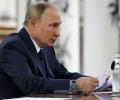
Russian President Vladimir Putin on Friday said that any direct contact or direct clash of North Atlantic Treaty Organisation (NATO) troops with the Russian army would lead to a 'global catastrophe'.
Expressing concern over the continuing buildup of nuclear weapons in South Asia, the United States has asked India and Pakistan to restrain their atomic and missile programmes and play a positive role in the global non-proliferation community.
